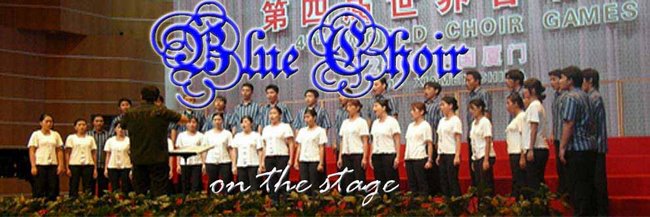
Selamat datang di Blog Blue Choir !

Blue Choir adalah suatu Wadah penyaluran minat dan bakat mahasiswa Fakultas Teknik Universitas Sam Ratulangi Manado di bidang Seni, dalam hal ini Paduan Suara.

Seiring dengan berjalannya waktu dan meningkatnya apresiasi mahasiswa dan dosen, serta didukung oleh seluruh civitas akademika fakultas teknik, Blue Choir telah mengikuti berbagai kompetisi baik nasional dan internasional.
Blog ini dibuat dengan tujuan supaya qta dapat berbagi pengetahuan agar supaya kedepannya bisa lebih baik lagi dalam berkarya.
Silahkan Kunjungi Website Blue Choir

Apabila ada komplain atas dimuatnya artikel yang ada di blog ini, berupa protes atas hak cipta, ketidaksenangan ketidakakuratan dan ketidak - ketidak lainnya, mohon maap !!!, karena tujuan dimuatnya artikel ini sekedar sharing, yah... sapa tau berguna to?, bagi para pencinta koor se indonesia dan mungkin kedepannya juga dapat mencontoh mereka - mereka ini sehingga kedepannya qta bisa sharing pengetahuan ... tetapi kalo ada yang memberi pujian .... ufh... tengkyu .. tengkyu, waktu tidur yang habis akibat browsing bisa terobati So... silahkan masukkan komentarnya ya?
Tampilkan postingan dengan label Teori Music. Tampilkan semua postingan

Before You Sing a Note: Scan for Tension !!!

by Suzann Kale

No matter how well-practiced we are, tension can always creep in. Any kind of physical tension (except for the natural tension necessary in your breathing technique) will hurt the quality of your voice.

Look, feel, and listen for the following "red flags" while you're singing or speaking. Then consciously let them go.

Elbows pressed too tightly against your body. (Antidote - Loosen up your arms. If you're practicing or in rehearsal, swing your arms and roll your shoulders.)

Knees locked. (Antidote - Walk around to unlock them. Dance, if appropriate.)

Lips tense. You can feel it if your lips are tight, and you can hear it as your sound becomes pinched. (Antidote - If you're vocalizing or in rehearsal, take a break and do lip trill exercises (p. 227 in Vocal Vibrance) or take a moment to gently move the muscles around in your face. If you're on stage, make sure you are dropping your jaw on the vowel sounds.)

A pinched sound or the beginnings of pain in the throat. (This means you're not breathing! The antidote - remember to breathe and sing from the diaphragm and lower rib area. When you inhale, only your midriff should expand - never your shoulders or upper chest.)

On upward interval jumps, you're not hitting the top note precisely. Or, you're hitting below the note and sliding up. (You're exhausted. Antidote - If you're vocalizing, it's time for a break. If you're new to singing, you may only be able to vocalize 10 to 20 minutes a day while your breathing muscles develop. If you're an experienced singer or if you're onstage when this happens, you've got to get that adrenaline going and consciously make those intercostal and diaphragm muscles work for you. Straightening your posture will help tremendously.)

Your knuckles around the microphone are turning white. (This indicates whole-body tension. It creeps up on the best of us. If you can be aware of it, you can let it go.)

Your voice sounds thinner than usual. (This is a part of stage fright. Antidote - Support that breath! Walk around while you're singing - walking loosens up the body. If you're between songs, talk to the audience, and laugh if you can work that in. Laughter is an immediate healer. Tell yourself that this gig is not the beginning and end of the world and remember that the Universe is made up of billions and billions of galaxies.)

AN ALTERNATIVE, SCIENCE-BASED THEORY OF REGISTER PHENOMENA

READ This PAPER ... It's Very Usefull for Singers ....

"This paper analyzes and evaluates several explicit and implicit assumptions that are embedded in the concepts, terminologies, and practices related to vocal registers. A reconciliation of the varied and conflicting register concepts, terminologies, and practices is proposed, including:

1. a brief historical context of vocal registers,

2. a documented science-based theory that accounts for vocal register phenomena from perceptual, physiological, and acoustical perspectives,

3. criteria for selection of science-based categorical word labels for register phenomena and suggested colloquial English terms that meet the criteria,

4. how the theory can be beneficially applied to the learning of efficient, skilled singing and speaking when guided by music educators, choral conductors, singing teachers, speech teachers, theatre directors, and when applied to therapeutic clinical settings."

Read MOre .....

How to Practise

HOW TO PRACTISE


By Craig Tompkins


Practising singing is different from practising an instrument. When we practise the violin, piano or trumpet, we leave the instrument when we are finished and don’t return to it until the next session. With the voice, our body is our instrument and it is always with us. Every time we speak, swallow, cough, sneeze, whisper, yell, sigh, hold our breath or clear our throat, we are using parts of our body that are also used for singing. An important way we differ from other musicians is that singers sing words and notes, and those words are often in other languages. To be good singers requires that we understand exactly what we’re singing about. This may mean sitting down with a dictionary and doing a word by word translation of the song text then speaking it until it becomes comfortable before we even learn a single note of music!

As a singer, it’s better to have several shorter practise sessions throughout the day instead of one marathon session as some instrumentalists do. The first practise session of the day is the most important, and is best done as early as possible (ideally before noon, but definitely after breakfast). This warm-up session should include a brief physical warm-up, humming, onset, agility, legato and vowel balancing exercises in the middle and lower range of the voice. Wait until later in the day to sing songs. The length of this session depends on the singer. Sometimes you can get your voice warmed up in just five or ten minutes; other times it still isn’t feeling right after half an hour. If you aren’t singing well after twenty or twenty-five minutes, it’s best to stop and come back to it later. There are many reasons why things may not be working: dehydration, stress, lack of sleep, allergies, food sensitivities, bad moods (your’s or someone else’s!), hormones, medications, a cold, other distractions, etc. etc. Also, as your sensitivity to the way your voice works and your skills increase, you will discover which are the most effective exercises and warm-up routines.

The next session can begin with a very short warm-up and proceed to exercises for range extension, vowel balancing and agility in the upper part of your voice. This session is also a good time to work on songs. Other practise sessions can include using special exercises for problem areas, reviewing previously learned songs, reinforcing new habits and reading music. It’s best to limit each practise session to a maximum of forty-five minutes of actual singing even at an advanced level. Because your voice is produced by two little flaps of skin in your voice box that rub together many, many times per second (over 260 times for middle C), we don’t want to overuse these delicate tissues!

If you are singing in a choir, try to do your personal warm-up before rehearsal starts so that you are ready to sing in a safe and healthy manner. On the days that you have choir practise, feel free to replace one or two of your later practise sessions with a silent session where you learn words, listen to recordings, study the music or do some other non-vocal activity that’s related to the songs you’re singing. As singers we are lucky because we can accomplish a lot with silent practise. When you are singing, make every note count!

Kamus Istilah Musik

Ufff.... Akhirnya dapa waktu jo kita mo posting di Blog, setelah sekian lama di serang wabah malas dan penyakit sibuk ... hehehehe..
All, mungkin torang perlu referensi ketika ingin menggarap sebuah lagu, baik untuk mengetahui latar belakang lagu atau pun ada beberapa istilah - istilah dalam partitur yang kita belum pahami baik tersurat maupun tersirat.
Untuk yang satu ini, kita selalu cari referensi di internet ( walau nda samua ) dan bertanya karena kita selalu memegang prinsip "malu bertanya sesat di jalan" [ tapi kalo talalu banyak batanya? :-) ]
Mungkin ada yang batanya dalam hati (salah satu kita), kyapa harus ada lebih dari 1 alternatif untuk mencari referensi? kan di internet ada samua ( kalo torang mo cari ), kyapa le musti babatanya? ......
nah sodara - sodara, di internet memang ada banyak sumber sekaligus jawaban tentang segala hal terlebih music, tapi lebih baik torang mendiskusikan hal - hal yang torang dapa di internet dengan orang - orang yang torang anggap Expert di bidang ini ( ini lantaran kita nda punya cukup ilmu untuk membuat kesimpulan sendiri ) tetapi kadang kalo torang mo batanya pa orang yang Expert di bidang ini susah - susah gampang, karena nda samua mo suka kase tahu ( yah... nasib, dorang tako sto jang torang mo 'lewat' pa dorang kang? hehehe....) jadi alangkah baiknya kalo ada lebih dari 1 sumber media, sehingga torang bole mo compare....
nah friends, mungkin ini boleh mo babantu walaupun cuma sadikiiiiiiii....., yaitu dengan adanya kamus istilah yang dapat di akses On Line, yaitu: Merriam Webster Dictionary, Music Dictionary, Virginia Tech Multimedia Music Dictionary, Dolmetsch OnLine, Contra Costa college Dictionary of Music Term, Music Dictionary glossary Terms, Music Outfitters.
web - web ini sangat membantu pa qta untuk pemahaman istilah - istilah music.
Semoga membantu.. GBU All.


Bach and the High Baroque

Setelah sekian lama nyanda ba surfing utk urusan di luar kerjaan, akhirnya dapa jo sebuah buku, lebih tepatnya buku suara/audio book tentang Bach and the High Baroque (mudah2an situs ini tetap ol).
Audio Book ini menjelaskan tentang Bach dan Semua Style ttg Artistick Karya Bach, yang dibuat per lesson sehingga lebih mudah menuntun qta dalam memahami karya - karya Bach.
Syarat utama utk dapat mengerti Audio Book ini adalah Kemampuan mendengar English yg baik, hehehehe......., selain itu harus punya waktu, uang dan bandwith yg cukup utk men-donlot Audio Booknya dalam format mp3

Read More .....

Singakademie Tsukuba

Selengkapnya lihat aja di websitenya, dan untuk sample mp3nya dapat di akses di sini atau dapat anda temukan di Kumpulan Sample mp3.

East West Symphonic Choir

Dalam situs East West Symphonic Choir ini, terdapat beberapa sample mp3 dan pada directory parentnya terdapat banyak hal - hal yag menarik seperti pelajaran guitar. selebihnya silahkan eksplore sendiri. bisa dilihat juga di Kumpulan Sample mp3

The Vocal Mechanism

Yang sangat menarik dari situs Western Illinois University Choirs ini, yaitu adanya artikel tentang teknik vokal. bagaimana seharusnya posisi larynx yang tepat dan berbagai tips - tips praktis untuk menghasilkan suara yang sehat.
selain itu juga tersedia beberapa hasil rekaman mereka dalam bentuk Mp3.
Hal yang menarik lainnya yaitu, adanya link - link yang sangat menarik untuk ditelusuri. ada beberapa link yang menyediakan sample Mp3 dari hasil rekaman mereka.

Mp3 and Concert Dress

MIT Chamber Chorus adalah sebuah wadah berkumpulnya mahasiswa dan alumni mereka dari berbagai disiplin ilmu. Choir ini selalu melakukan konser kira - kira 2 kali dalam setahun dengan Dr. William Cutter sebagai Artistic Directornya. Mereka memfokuskan diri ke repertoire chamber standart untuk small vocal ensemble. Mereka waktu qta beking ini tulisan ada tampil di Vienna dan Budapest dalam rangkaian MIT Tour Choir. Mereka juga sering tampil bersama Aardvark Jazz Orchestra, the MIT Wind Ensemble, dan MIT Symphony Orchestra, dan mereka memberikan beberapa hasik rekaman mereka dalam bentuk mp3.
Ada artikel menarik juga di posting dalam situs ini, yaitu tentang pakaian dan pengaruhnya pada penampilan. ini kutipannya :

For those of you new to the choir (and as a reminder to the rest), concert dress is FORMAL!!! Start looking for something to wear early. Information on what both women and men are expected to wear is below. If you have questions that are not answered by the information below, please ask our conductor.

Do NOT wear:

  • perfume
  • cologne
  • aftershave
  • any scented personal care item
Read more...

What is music?

What is music?
Artikel ini diambil dari situs Umeå Akademiska Kör. yang banyak memuat tentang teori musik dari Era ke era. dalam situs ini di muat lengkap dengan teori music beserta tima line nya.